My genealogy friend and colleague Liz Loveland invited me to take part in a Writers' Blog Tour to encourage sharing among writers about their current projects through their blog sites. Liz's Tour post is viewable at her blog site, My Adventures in Genealogy. Each Tour participant answers four questions about their writing, and then introduces other writers to continue the Tour.
What am I working on?
I am currently working on a story concerning my ancestor’s experience in the 27th Connecticut Infantry Volunteer Regiment during the Civil War. He was killed in his first battle on December 13, 1862 during the ill-fated attempts by the Union Army to seize Marye’s Heights at Fredericksburg. The story of his experience is compelling because it is so tragic. A young man in the prime of his life is cut down by the ravages of war before he has the chance to experience all that life has to offer. The episode in which he was killed is even more heartbreaking when one recognizes that the repeated assaults on Marye’s Heights were intended as diversionary movements by the Union Army to draw Confederate forces away from Prospect Hill, the pivotal military objective for winning the battle.
How does my work differ from others of its genre?
I’m not certain that my work does differ from other historical writing except, perhaps, for my perspectives on it. I am writing my ancestor’s story in two separate presentations: one as historical nonfiction and another as creative nonfiction. The creative presentation allows more freedom in my writing, as I can present his Civil War experience as a historical and spiritual journey through the lens of my head and heart. Unfortunately I have no actual letters or journals written by my ancestor, but I have come to know him by reading what his officers and comrades have written about him. I have visited Fredericksburg several times and have walked the ground where he fell. I have travelled to New Haven, Connecticut, where he was born and lived his entire life before military service. I have paid my respects at the family plot at Grove Street Cemetery in New Haven where his parents and siblings are buried and where a memorial gravestone was placed in his honor. My personal experiences in following in his footsteps have become intertwined with his journey. My hope is to create a compelling, inspirational story that others will want to read.
Why do I write what I do?
I write because I am passionate about history and genealogical research. The study of history reveals that the challenges that our ancestors faced are still very relevant on a human level today. Historical and genealogical research is endlessly fascinating, as there is always something new to learn about the past. History has always been captivating for me, as the story is inevitably influenced by the one who reports it. A report of a single event told by many authors always differs in a tantalizing way. Some aspect of the truth is present in every historical story, and many aspects of the story are colored by the perspectives of the author. The challenge for the reader is to discern between the truth and the bias.
In particular the Civil War era has been very compelling for me, as the experiences of the soldiers at the edge of warfare and their families on the home front are exposed to the full range of the human emotional experience. Love, sacrifice, tragedy, grief, anger, and fear are ever present in these stories.
I write regularly about my genealogical discoveries and experiences in my Journeys of a Constant Genealogist blog. I am also documenting three of my ancestor’s Civil War experiences in sesquicentennial tribute blogs to their regiments, posting blog entries on dates significant to the history of the regiment. I created these tribute blogs to honor the men who served in these regiments, but in return I have been honored. In the process I have learned so much about their experiences and the challenges they faced in battle. I am often in awe or in tears at what they endured.
How does my writing process work?
I generally begin with an outline to clarify my thoughts surrounding my project, but I must confess that my best inspirations come when I am very relaxed, either while sleeping at night or while driving to work. My current project concerning my Civil War ancestor has been beckoning to me especially at night while I sleep. I believe that this type of inspiration is very powerful, very spiritual, and not to be ignored.
Introducing the next Tour participant.
I have the pleasure of introducing the next participant on the Tour, who writes about social history. I hope to have at least one other participant to introduce shortly.
Lori Lyn Price is a genealogist, a professional speaker and a historical researcher. She writes about social history for genealogists at her BridgingThePast.com blog. She is using her 3rd great-grandfather as a case study and plans to use his life as a lens for a book about Mormon culture and history in the 1800s. She is working towards a Master's degree in history. Her thesis is based on medicinal recipes from the 1600s. Lori Lyn showcases her blog tour post on on her personal blog Drewmeister and discusses it on her social history blog Bridging the Past.
Wednesday, July 30, 2014

Remembering the Battle of the Crater at Petersburg - 150 Years Later
Today marks the sesquicentennial anniversary of the Battle of the Crater, a Civil War episode during the ten-month Siege of Petersburg, Virginia that began in June 1864 and ended in April 1865. A plan to dig tunnels under the Confederate position at Petersburg was implemented during the month of July 1864, and at 4:40 A.M. on July 30, 1864, a mine exploded underneath the Confederate position, leaving a wide crater. The Ninth Corps of the Union Army charged into the thirty-foot deep crater to overtake the Confederates, with the Eighteenth Corps remaining along the front lines in support. The attack ended in devastating failure for the Union, as the Confederates charged to the defense of their men by lining along the rim of the gaping hole and firing into the men of the Ninth Corps inside the crater. Massive losses from death or capture for the Ninth Corps were the tragic result of the catastrophic episode. Casualties mounted to nearly 5,000 for the Union and 1,000 for the Confederacy.
These modern-day pictures of the remnants of the Crater illustrate that time and exposure to the elements have eroded the destruction wrought by the mine explosion.


This plaque near the Crater at Petersburg reads:
Crater of Mine
Evacuated By
The 48th Regt. Penn. Vet. Vol. Inf.
Burnside's 9th Corps.
July 30, 1864
These modern-day pictures of the remnants of the Crater illustrate that time and exposure to the elements have eroded the destruction wrought by the mine explosion.


This plaque near the Crater at Petersburg reads:
Crater of Mine
Evacuated By
The 48th Regt. Penn. Vet. Vol. Inf.
Burnside's 9th Corps.
July 30, 1864
Monday, July 28, 2014
My Great-Grandmother's Quilt
Recently while vacationing in Vermont my husband and I had the pleasure to stop by the Shelburne Museum to view a quilt crafted by my great-grandmother Martha Kimberly (1860 - 1929) when she was fourteen years old. She constructed the quilt with her eleven-year old sister Augusta (1862 - 1952) as a wedding gift for their older sister Eleanor, known as Ellen May (1850 - 1927), pictured below, in 1873.1 The Kimberlys were a farming family from the Nepaug village of New Hartford, Connecticut. For additional information about the Kimberly family please see my Kimberly Family Tree information.

The tile quilt, named "Streets of Boston," is a patchwork similar to a "crazy quilt" design.
 2
2
I learned about the quilt from a book entitled Tile Quilt Revival: Reinventing a Forgotten Form on Google Books shortly after the book was published in 2010. The book mentions that the quilt was on display in Japan in 1997 as part of the Shelburne Museum collection and that some of the symbols on the quilt represent locations in Boston, namely, that the center block is Boston Common, the star at the top is Fort Independence, and the double circle is the Bunker Hill Monument. The book indicates further that these symbols were common on nineteenth-century maps to mark historic sites. 3
The quilt was donated to the Shelburne Museum by Eleanor Pedersen Craig (1911 - 2011), Ellen's granddaughter, in 1982. Along with the quilt Eleanor donated several family photographs that I have posted to the Photos page of my Kimberly Family Genealogy blog site. Eleanor also photocopied pages from the Baldwin-Kimberly Family Bible that I have transcribed and posted to the Family Bible page of the Kimberly blog site.
Eleanor P. Craig is pictured below with her mother, Grace (Chantrell) Pedersen (1882 - 1974), with Grace on the left and Eleanor on the right. This picture was taken during the 1940s.

I wish to thank Barbara Rathburn, Registrar at the Shelburne Museum, for her cooperation and assistance in viewing these family treasures and for her permission in posting the photos. I also wish to extend my gratitude to Eleanor P. Craig for her generosity and thoughtfulness in sharing the quilt and photos in her donation to the Shelburne Museum.
References:
1Martha and Augusta Kimberly, "Streets of Boston," quilt, 1873, item 1982-2, quilt no. 10-601, Quilt Collection, Shelburne Museum, Shelburne, Vermont. Martha and Augusta Kimberly, age 14 and 11 respectfully, made the quilt as a wedding gift for their older sister Ellen May (1850-1927), who was affectionately called Nellie.
2Martha and Augusta Kimberly, "Streets of Boston," quilt photographed by Carol Swaine-Kuzel, 3 July 2014.
3Carol Gilham Jones and Bobby Finley, Tile Quilt Revival: Reinventing a Forgotten Form (Concord, Calif.: C&T Publishing Inc., 2010), 6.

The tile quilt, named "Streets of Boston," is a patchwork similar to a "crazy quilt" design.
 2
2
I learned about the quilt from a book entitled Tile Quilt Revival: Reinventing a Forgotten Form on Google Books shortly after the book was published in 2010. The book mentions that the quilt was on display in Japan in 1997 as part of the Shelburne Museum collection and that some of the symbols on the quilt represent locations in Boston, namely, that the center block is Boston Common, the star at the top is Fort Independence, and the double circle is the Bunker Hill Monument. The book indicates further that these symbols were common on nineteenth-century maps to mark historic sites. 3
The quilt was donated to the Shelburne Museum by Eleanor Pedersen Craig (1911 - 2011), Ellen's granddaughter, in 1982. Along with the quilt Eleanor donated several family photographs that I have posted to the Photos page of my Kimberly Family Genealogy blog site. Eleanor also photocopied pages from the Baldwin-Kimberly Family Bible that I have transcribed and posted to the Family Bible page of the Kimberly blog site.
Eleanor P. Craig is pictured below with her mother, Grace (Chantrell) Pedersen (1882 - 1974), with Grace on the left and Eleanor on the right. This picture was taken during the 1940s.

I wish to thank Barbara Rathburn, Registrar at the Shelburne Museum, for her cooperation and assistance in viewing these family treasures and for her permission in posting the photos. I also wish to extend my gratitude to Eleanor P. Craig for her generosity and thoughtfulness in sharing the quilt and photos in her donation to the Shelburne Museum.
References:
1Martha and Augusta Kimberly, "Streets of Boston," quilt, 1873, item 1982-2, quilt no. 10-601, Quilt Collection, Shelburne Museum, Shelburne, Vermont. Martha and Augusta Kimberly, age 14 and 11 respectfully, made the quilt as a wedding gift for their older sister Ellen May (1850-1927), who was affectionately called Nellie.
2Martha and Augusta Kimberly, "Streets of Boston," quilt photographed by Carol Swaine-Kuzel, 3 July 2014.
3Carol Gilham Jones and Bobby Finley, Tile Quilt Revival: Reinventing a Forgotten Form (Concord, Calif.: C&T Publishing Inc., 2010), 6.
Friday, June 27, 2014
Discover the Civil War at Mount Auburn - June 21, 2014
On Saturday I attended a Civil War theme walk at Mount Auburn Cemetery entitled Discover the Civil War at Mount Auburn, an ongoing series of walks held at Mount Auburn regularly during the year.
The walk focused on notable figures who participated in political or civilian service on the home front and in military service in the Civil War.
We traveled along a wide loop of the cemetery, beginning and ending at the Story Chapel near the entrance gate. We stopped at famous gravesites visited on previous walking tours, included the Sphinx, the Shaw Memorial, Dorothea Dix, Henry Todd, Dr. Samuel Howe and wife Julia Ward Howe, Edwin Booth, Charles Sumner, the Revere family, Colonel Thomas Cass, Joseph Hills, and Henry Wadsworth Longfellow. For additional information about these famous burials please visit Splendors of Mount Auburn Cemetery for the Sphinx and the Shaw Memorial, Boston in the Civil War Walk at Mount Auburn Cemetery for the Howe family, Charles Sumner, the Revere family, and Colonel Thomas Cass, and Discover the Civil War at Mount Auburn Walk - September 21, 2013 for Dorothea Dix, Henry Todd, Edwin Booth , Joseph Hills, and Henry Wadsworth Longfellow. In this post I am focusing on gravesites not visited in previous Mount Auburn walking tour posts.
Our first stop was the memorial to mathematician and astronomer Nathaniel Bowditch (1773-1838) on Chapel Avenue, situated near the Sphinx and across from the Bigelow Chapel. Nathaniel is buried in the Bowditch family lot on Tulip Path, which was not included on our walk.


Rev. Charles Turner Torrey (1813 - 1846) was a Congregational minister and a tireless abolitionist who died for the abolitionist cause. In 1844 he was sentenced to six years in the Maryland State Penitentiary, convicted on slave-stealing charges while attempting to lead slaves to freedom through the Underground Railroad in Baltimore. During his captivity in prison he succumbed to tuberculosis.

 1
1
William T.G. Morton (1819 - 1868) was a dentist who pioneered the use of ether as anesthesia for his patients. During the Civil War he enlisted as a volunteer surgeon and administered ether to wounded soldiers at the Battles of Fredericksburg, Chancellorsville, and the Wilderness.
 2
2
Lieutenant Colonel James Savage of the Second Massachusetts Infantry Regiment died October 22, 1862 as a prisoner of war from wounds received at the Battle of Cedar Mountain on August 9, 1862. This gravestone in Mount Auburn Cemetery is a cenotaph, as his body lies in Virginia. A carte de visite photograph of Lieutenant Colonel Savage can be viewed on the Massachusetts Historical Society website.
 3
3
Edward Everett (1794 - 1865) was a U.S. Representative and Senator from Massachusetts and also served as Governor of Massachusetts from 1836 to 1840. He was recognized for his elocution skills, most notably for his long speech at the dedication of the Soldiers’ Cemetery at Gettysburg on November 21, 1863. Everett’s two-hour speech preceded the two-minute speech of President Abraham Lincoln. Lincoln’s 272-word speech, the Gettysburg Address, eclipsed Everett’s presentation and has since been recognized as a masterpiece of our historical landscape, . After President Lincoln’s concise and eloquent delivery at Gettysburg Everett remarked to Lincoln, "I should be glad if I could flatter myself that I came as near to the central idea of the occasion, in two hours, as you did in two minutes."

 4
4
Thomas Edward Chickering (1824 – 1871) was the son of Jonas Chickering, founder of Chickering and Sons, one of the earliest piano manufacturers in the United States. During the Civil War Thomas was promoted to Colonel of 41st Massachusetts Volunteer Infantry, which was later consolidated with three Cavalry units to become the 3rd Massachusetts Cavalry during the Siege of Port Hudson, Louisiana, in 1863. He was also appointed military governor of Opelousas, Louisiana. In 1866 he received the honorary rank of brevet brigadier general for his Civil War service. In postwar civilian life he was the senior partner of Chickering and Sons until his death in 1871 at the age of 47 years.
 5
5
Sergeant Major Joseph Oliver Miles served in Company D of the 13th Massachusetts Infantry and died of disease on August 5, 1864.
 6
6
George Lewis Ruffin (1834 – 1886) was an attorney and judge. He was the first African American to graduate from Harvard Law School. George served on the Boston City Council and was elected to the Massachusetts State Council. He was appointed as a judge to the Charlestown District Municipal Court, becoming the first African American judge in the United States. His wife, Josephine St. Pierre Ruffin (1842 – 1924) was a pioneer for social justice, founding the first newspaper for African American women, Women’s Era, and organizing the advocacy group, the National Federation of African-American Women, which later merged with the Colored Women’s League to become the National Association of Colored Women’s Clubs. Josephine also founded the Women’s Era Club which later became the New Era Club.
 7
7
Charles Appleton Longfellow (1844 – 1893), son of Fireside poet Henry Wadsworth Longfellow and second wife Fanny Appleton, served as a Lieutenant in the First Massachusetts Cavalry during the Civil War. He survived the war and resumed his passion for yachting, making sea journeys to Russia, China, Japan, and Indonesia.
 8
8
I was deeply moved by episodes in the lives of the Bowditch family observed during a recent PBS American Experience documentary entitled Death and the Civil War, and I decided to visit the Bowditch lot on Tulip Path after the walk concluded to pay my respects.
Nathaniel Bowditch (1773-1838) was a mathematician, astronomer and navigator, and the founder of modern maritime navigation. He authored a book on navigation, The New American Practical Navigator, which is widely used today and is carried on board every commissioned U.S. naval ship. 9
9
Nathaniel's son Henry Ingersoll Bowditch (1808-1892), was a physician and abolitionist. The recent PBS American Experience documentary, Death and the Civil War, based on Drew Gilpin Faust's book This Republic of Suffering: Death and the American Civil War, showcased Henry's devotion to his son Nathaniel, a Lieutenant in the First Massachusetts Cavalry, who was mortally wounded during a cavalry charge at Kelly's Ford on March 17, 1863. Dr. Bowditch believed that his son would not have died if an ambulance system had been available to evacuate his son from the battlefield in a timely fashion. Motivated by grief but inspired by love Dr. Bowditch became an unceasing advocate for an ambulance system that was instituted by the Union Army in the spring of 1864.
 10
10
Nathaniel Bowditch (1839-1863), Henry's son, was a Lieutenant in the First Massachusetts Cavalry Brigade and Assistant Adjutant General to Colonel Alfred Duffié. He was mortally wounded during a cavalry charge at Kelly's Ford on March 17, 1863.

 11
11
For additional information about Civil War walks at Mount Auburn please visit http://mountauburn.org/tag/civil-war/. For other events at Mount Auburn please visit their calendar of events at http://www.mountauburn.org/category/events. For additional information about previous Civil War walks at Mount Auburn Cemetery please visit my blog posts labeled Mount Auburn Cemetery and Civil War Walking Tours.
For additional information about the excellent American Experience PBS documentary Death and the Civil War please visit http://www.pbs.org/wgbh/americanexperience/films/death/. A full transcript of the documentary is available at http://www.pbs.org/wgbh/americanexperience/features/transcript/death-transcript/.
References:
1Mount Auburn Cemetery (Cambridge, Middlesex County, Massachusetts), Charles Turner Torrey monument, Spruce Avenue, Lot 1282, photographed by Carol Swaine-Kuzel, 21 June 2014. "Charles Turner Torrey," Charles Turner Torrey - Wikipedia, the Free Encyclopedia (http://en.wikipedia.org/wiki/Charles_Turner_Torrey: 27 June 2014).
2Mount Auburn Cemetery, William T. G. Morton monument, Spruce Avenue, Lot 3940, photographed by Carol Swaine-Kuzel, 21 June 2014. "William T. G. Morton," William T. G. Morton - Wikipedia, the Free Encyclopedia (http://en.wikipedia.org/wiki/William_T._G._Morton: 27 June 2014).
3Mount Auburn Cemetery, James Savage marker, Walnut Avenue, Lot 178, photographed by Carol Swaine-Kuzel, 21 June 2014. "Massachusetts in the Civil War 1861-1862," Massachusetts Historical Society: Cedar Mountain (http://www.masshist.org/features/massachusetts-in-the-civil-war-1861-1862/cedar-mountain: 27 June 2014).
4Mount Auburn Cemetery, Edward Everett marker, Magnolia Avenue, Lot 17, photographed by Carol Swaine-Kuzel, 21 June 2014. "Edward Everett," Edward Everett - Wikipedia, the Free Encyclopedia (http://en.wikipedia.org/wiki/Edward_Everett: 27 June 2014).
5Mount Auburn Cemetery, Chickering family monument, Magnolia Avenue, Lot 2282, photographed by Carol Swaine-Kuzel, 21 June 2014. "Thomas Edward Chickering," Thomas Edward Chickering - Wikipedia, the Free Encyclopedia (http://en.wikipedia.org/wiki/Thomas_Edward_Chickering: 27 June 2014).
6Mount Auburn Cemetery, Joseph Miles marker, Chestnut Avenue, Lot 1053, photographed by Carol Swaine-Kuzel, 21 June 2014.
7Mount Auburn Cemetery, Ruffin family monument, Indian Ridge Path, Lot 4960, photographed by Carol Swaine-Kuzel, 21 June 2014. "George Lewis Ruffin," George Lewis Ruffin - Wikipedia, the Free Encyclopedia (http://en.wikipedia.org/wiki/George_Lewis_Ruffin: 27 June 2014). "Josephine St. Pierre Ruffin," Josephine St. Pierre Ruffin - Wikipedia, the Free Encyclopedia (http://en.wikipedia.org/wiki/Josephine_St._Pierre_Ruffin: 27 June 2014).
8Mount Auburn Cemetery, Charles Appleton Longfellow marker, Indian Ridge Path, Lot 580, photographed by Carol Swaine-Kuzel, 21 June 2014. "Charles Longfellow," Charles Longfellow - Longfellow House Washington's Headquarters National Historic Site (http://www.nps.gov/long/historyculture/charles-longfellow.htm: 27 June 2014).
9Mount Auburn Cemetery, Nathaniel Bowditch marker, Tulip Path, Lot 1207, photographed by Carol Swaine-Kuzel, 21 June 2014. "Nathaniel Bowditch," Nathaniel Bowditch - Wikipedia, the Free Encyclopedia (http://en.wikipedia.org/wiki/Nathaniel_Bowditch: 27 June 2014).
10Mount Auburn Cemetery, Henry Ingersoll Bowditch marker, Tulip Path, Lot 1206, photographed by Carol Swaine-Kuzel, 21 June 2014. "Transcript: Death and the Civil War," Transcript. Death and the Civil War. American Experience. WGBH|PBS. (http://www.pbs.org/wgbh/americanexperience/features/transcript/death-transcript/: 27 June 2014).
11Mount Auburn Cemetery, Nathaniel Bowditch marker, Tulip Path, Lot 1206, photographed by Carol Swaine-Kuzel, 21 June 2014.
The walk focused on notable figures who participated in political or civilian service on the home front and in military service in the Civil War.
We traveled along a wide loop of the cemetery, beginning and ending at the Story Chapel near the entrance gate. We stopped at famous gravesites visited on previous walking tours, included the Sphinx, the Shaw Memorial, Dorothea Dix, Henry Todd, Dr. Samuel Howe and wife Julia Ward Howe, Edwin Booth, Charles Sumner, the Revere family, Colonel Thomas Cass, Joseph Hills, and Henry Wadsworth Longfellow. For additional information about these famous burials please visit Splendors of Mount Auburn Cemetery for the Sphinx and the Shaw Memorial, Boston in the Civil War Walk at Mount Auburn Cemetery for the Howe family, Charles Sumner, the Revere family, and Colonel Thomas Cass, and Discover the Civil War at Mount Auburn Walk - September 21, 2013 for Dorothea Dix, Henry Todd, Edwin Booth , Joseph Hills, and Henry Wadsworth Longfellow. In this post I am focusing on gravesites not visited in previous Mount Auburn walking tour posts.
Our first stop was the memorial to mathematician and astronomer Nathaniel Bowditch (1773-1838) on Chapel Avenue, situated near the Sphinx and across from the Bigelow Chapel. Nathaniel is buried in the Bowditch family lot on Tulip Path, which was not included on our walk.


Rev. Charles Turner Torrey (1813 - 1846) was a Congregational minister and a tireless abolitionist who died for the abolitionist cause. In 1844 he was sentenced to six years in the Maryland State Penitentiary, convicted on slave-stealing charges while attempting to lead slaves to freedom through the Underground Railroad in Baltimore. During his captivity in prison he succumbed to tuberculosis.

 1
1William T.G. Morton (1819 - 1868) was a dentist who pioneered the use of ether as anesthesia for his patients. During the Civil War he enlisted as a volunteer surgeon and administered ether to wounded soldiers at the Battles of Fredericksburg, Chancellorsville, and the Wilderness.
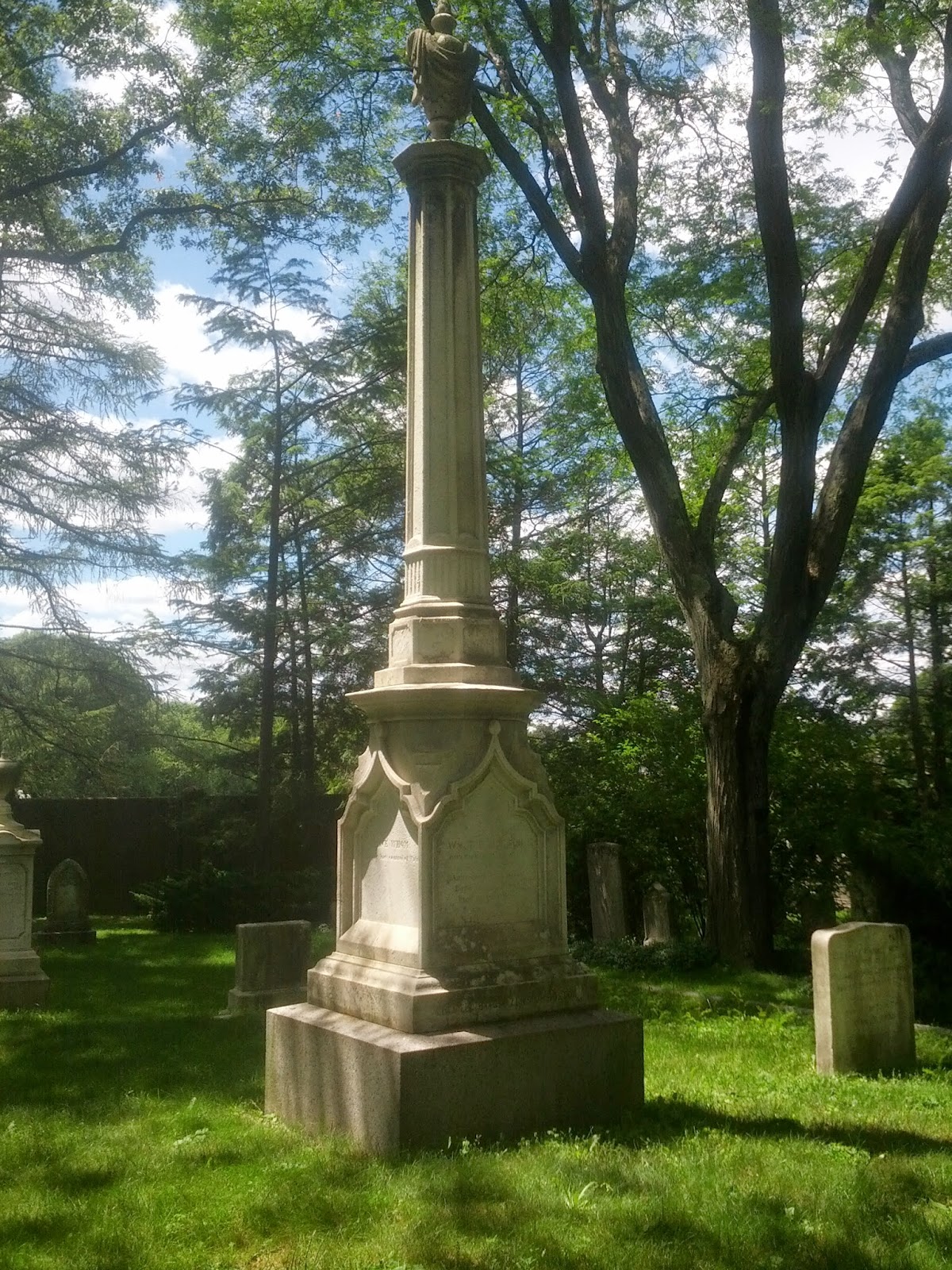 2
2Lieutenant Colonel James Savage of the Second Massachusetts Infantry Regiment died October 22, 1862 as a prisoner of war from wounds received at the Battle of Cedar Mountain on August 9, 1862. This gravestone in Mount Auburn Cemetery is a cenotaph, as his body lies in Virginia. A carte de visite photograph of Lieutenant Colonel Savage can be viewed on the Massachusetts Historical Society website.
 3
3Edward Everett (1794 - 1865) was a U.S. Representative and Senator from Massachusetts and also served as Governor of Massachusetts from 1836 to 1840. He was recognized for his elocution skills, most notably for his long speech at the dedication of the Soldiers’ Cemetery at Gettysburg on November 21, 1863. Everett’s two-hour speech preceded the two-minute speech of President Abraham Lincoln. Lincoln’s 272-word speech, the Gettysburg Address, eclipsed Everett’s presentation and has since been recognized as a masterpiece of our historical landscape, . After President Lincoln’s concise and eloquent delivery at Gettysburg Everett remarked to Lincoln, "I should be glad if I could flatter myself that I came as near to the central idea of the occasion, in two hours, as you did in two minutes."

 4
4Thomas Edward Chickering (1824 – 1871) was the son of Jonas Chickering, founder of Chickering and Sons, one of the earliest piano manufacturers in the United States. During the Civil War Thomas was promoted to Colonel of 41st Massachusetts Volunteer Infantry, which was later consolidated with three Cavalry units to become the 3rd Massachusetts Cavalry during the Siege of Port Hudson, Louisiana, in 1863. He was also appointed military governor of Opelousas, Louisiana. In 1866 he received the honorary rank of brevet brigadier general for his Civil War service. In postwar civilian life he was the senior partner of Chickering and Sons until his death in 1871 at the age of 47 years.
 5
5Sergeant Major Joseph Oliver Miles served in Company D of the 13th Massachusetts Infantry and died of disease on August 5, 1864.
 6
6George Lewis Ruffin (1834 – 1886) was an attorney and judge. He was the first African American to graduate from Harvard Law School. George served on the Boston City Council and was elected to the Massachusetts State Council. He was appointed as a judge to the Charlestown District Municipal Court, becoming the first African American judge in the United States. His wife, Josephine St. Pierre Ruffin (1842 – 1924) was a pioneer for social justice, founding the first newspaper for African American women, Women’s Era, and organizing the advocacy group, the National Federation of African-American Women, which later merged with the Colored Women’s League to become the National Association of Colored Women’s Clubs. Josephine also founded the Women’s Era Club which later became the New Era Club.
 7
7Charles Appleton Longfellow (1844 – 1893), son of Fireside poet Henry Wadsworth Longfellow and second wife Fanny Appleton, served as a Lieutenant in the First Massachusetts Cavalry during the Civil War. He survived the war and resumed his passion for yachting, making sea journeys to Russia, China, Japan, and Indonesia.
 8
8I was deeply moved by episodes in the lives of the Bowditch family observed during a recent PBS American Experience documentary entitled Death and the Civil War, and I decided to visit the Bowditch lot on Tulip Path after the walk concluded to pay my respects.
Nathaniel Bowditch (1773-1838) was a mathematician, astronomer and navigator, and the founder of modern maritime navigation. He authored a book on navigation, The New American Practical Navigator, which is widely used today and is carried on board every commissioned U.S. naval ship.
 9
9Nathaniel's son Henry Ingersoll Bowditch (1808-1892), was a physician and abolitionist. The recent PBS American Experience documentary, Death and the Civil War, based on Drew Gilpin Faust's book This Republic of Suffering: Death and the American Civil War, showcased Henry's devotion to his son Nathaniel, a Lieutenant in the First Massachusetts Cavalry, who was mortally wounded during a cavalry charge at Kelly's Ford on March 17, 1863. Dr. Bowditch believed that his son would not have died if an ambulance system had been available to evacuate his son from the battlefield in a timely fashion. Motivated by grief but inspired by love Dr. Bowditch became an unceasing advocate for an ambulance system that was instituted by the Union Army in the spring of 1864.
 10
10Nathaniel Bowditch (1839-1863), Henry's son, was a Lieutenant in the First Massachusetts Cavalry Brigade and Assistant Adjutant General to Colonel Alfred Duffié. He was mortally wounded during a cavalry charge at Kelly's Ford on March 17, 1863.

 11
11For additional information about Civil War walks at Mount Auburn please visit http://mountauburn.org/tag/civil-war/. For other events at Mount Auburn please visit their calendar of events at http://www.mountauburn.org/category/events. For additional information about previous Civil War walks at Mount Auburn Cemetery please visit my blog posts labeled Mount Auburn Cemetery and Civil War Walking Tours.
For additional information about the excellent American Experience PBS documentary Death and the Civil War please visit http://www.pbs.org/wgbh/americanexperience/films/death/. A full transcript of the documentary is available at http://www.pbs.org/wgbh/americanexperience/features/transcript/death-transcript/.
References:
1Mount Auburn Cemetery (Cambridge, Middlesex County, Massachusetts), Charles Turner Torrey monument, Spruce Avenue, Lot 1282, photographed by Carol Swaine-Kuzel, 21 June 2014. "Charles Turner Torrey," Charles Turner Torrey - Wikipedia, the Free Encyclopedia (http://en.wikipedia.org/wiki/Charles_Turner_Torrey: 27 June 2014).
2Mount Auburn Cemetery, William T. G. Morton monument, Spruce Avenue, Lot 3940, photographed by Carol Swaine-Kuzel, 21 June 2014. "William T. G. Morton," William T. G. Morton - Wikipedia, the Free Encyclopedia (http://en.wikipedia.org/wiki/William_T._G._Morton: 27 June 2014).
3Mount Auburn Cemetery, James Savage marker, Walnut Avenue, Lot 178, photographed by Carol Swaine-Kuzel, 21 June 2014. "Massachusetts in the Civil War 1861-1862," Massachusetts Historical Society: Cedar Mountain (http://www.masshist.org/features/massachusetts-in-the-civil-war-1861-1862/cedar-mountain: 27 June 2014).
4Mount Auburn Cemetery, Edward Everett marker, Magnolia Avenue, Lot 17, photographed by Carol Swaine-Kuzel, 21 June 2014. "Edward Everett," Edward Everett - Wikipedia, the Free Encyclopedia (http://en.wikipedia.org/wiki/Edward_Everett: 27 June 2014).
5Mount Auburn Cemetery, Chickering family monument, Magnolia Avenue, Lot 2282, photographed by Carol Swaine-Kuzel, 21 June 2014. "Thomas Edward Chickering," Thomas Edward Chickering - Wikipedia, the Free Encyclopedia (http://en.wikipedia.org/wiki/Thomas_Edward_Chickering: 27 June 2014).
6Mount Auburn Cemetery, Joseph Miles marker, Chestnut Avenue, Lot 1053, photographed by Carol Swaine-Kuzel, 21 June 2014.
7Mount Auburn Cemetery, Ruffin family monument, Indian Ridge Path, Lot 4960, photographed by Carol Swaine-Kuzel, 21 June 2014. "George Lewis Ruffin," George Lewis Ruffin - Wikipedia, the Free Encyclopedia (http://en.wikipedia.org/wiki/George_Lewis_Ruffin: 27 June 2014). "Josephine St. Pierre Ruffin," Josephine St. Pierre Ruffin - Wikipedia, the Free Encyclopedia (http://en.wikipedia.org/wiki/Josephine_St._Pierre_Ruffin: 27 June 2014).
8Mount Auburn Cemetery, Charles Appleton Longfellow marker, Indian Ridge Path, Lot 580, photographed by Carol Swaine-Kuzel, 21 June 2014. "Charles Longfellow," Charles Longfellow - Longfellow House Washington's Headquarters National Historic Site (http://www.nps.gov/long/historyculture/charles-longfellow.htm: 27 June 2014).
9Mount Auburn Cemetery, Nathaniel Bowditch marker, Tulip Path, Lot 1207, photographed by Carol Swaine-Kuzel, 21 June 2014. "Nathaniel Bowditch," Nathaniel Bowditch - Wikipedia, the Free Encyclopedia (http://en.wikipedia.org/wiki/Nathaniel_Bowditch: 27 June 2014).
10Mount Auburn Cemetery, Henry Ingersoll Bowditch marker, Tulip Path, Lot 1206, photographed by Carol Swaine-Kuzel, 21 June 2014. "Transcript: Death and the Civil War," Transcript. Death and the Civil War. American Experience. WGBH|PBS. (http://www.pbs.org/wgbh/americanexperience/features/transcript/death-transcript/: 27 June 2014).
11Mount Auburn Cemetery, Nathaniel Bowditch marker, Tulip Path, Lot 1206, photographed by Carol Swaine-Kuzel, 21 June 2014.
Tuesday, June 24, 2014
Remembering Oliver Bates at Petersburg - 150 Years Later
This week marks the premier conflict of Union General Ulysses S. Grant's Petersburg Campaign, the Battle of Jerusalem Plank Road. This battle marked another costly engagement between the two armies. The 20th Massachusetts Regiment gave exemplary service on this day by holding their position and repelling furhter attacks by Conferate General William Mahone.
My second great-granduncle Oliver Bates served with the 20th Massachusetts Infantry Regiment at Petersburg and was severely wounded while serving on picket duty along the Jerusalem Plank Road. He was wounded in the left leg by an exploding shell and was carried to the Second Division Hospital at City Point where Doctor Nathan Hayward found it necessary to amputate his leg. He was subsequently transported to Slough Barracks Hospital in Alexandria for hospital care.1
For additional information about Oliver Bates and the 20th Massachusetts Infantry Regiment please visit http://20thmassregt150.blogspot.com.
References:
1Compiled service record, Oliver S. Bates, Pvt., Co. A, 20th Massachusetts Infantry; Carded Records, Volunteer Organizations, Civil War; Records of the Adjutant General's Office, 1780s-1917, Record Group 94; National Archives, Washington, D.C.
My second great-granduncle Oliver Bates served with the 20th Massachusetts Infantry Regiment at Petersburg and was severely wounded while serving on picket duty along the Jerusalem Plank Road. He was wounded in the left leg by an exploding shell and was carried to the Second Division Hospital at City Point where Doctor Nathan Hayward found it necessary to amputate his leg. He was subsequently transported to Slough Barracks Hospital in Alexandria for hospital care.1
For additional information about Oliver Bates and the 20th Massachusetts Infantry Regiment please visit http://20thmassregt150.blogspot.com.
References:
1Compiled service record, Oliver S. Bates, Pvt., Co. A, 20th Massachusetts Infantry; Carded Records, Volunteer Organizations, Civil War; Records of the Adjutant General's Office, 1780s-1917, Record Group 94; National Archives, Washington, D.C.
Friday, June 20, 2014
MSOG June Meeting - Technology Presentation by Dick Eastman
On Saturday I attended the June meeting of the Massachusetts Society of Genealogists held at the Acton Public Library. Dick Eastman led a presentation on "New Genealogy Research Techniques," focusing on the changes in technology in general and for genealogists in particular. Dick highlighted three genealogical websites that offer advanced techniques for automated record searches and matching: Ancestry.com, Mocavo.com, and MyHeritage.com. The principal bonus for these websites is that each provides automated search capabilities across the Internet for records that may be relevant to ancestors in your family tree and provides notifications for the automated search results. The slides for the presentation are available directly from http://www.eogn.com/handouts/research or from the MSOG website at http://www.massachusettssocietyofgenealogists.org/middlesex.php
Tuesday, June 3, 2014
Remembering the Battle of Cold Harbor - 150 Years Later
This week marks the sesquicentennial anniversary of the final conflict of Union General Ulysses S. Grant's Overland Campaign, the Battle of Cold Harbor, one of the costliest defeats for the Union army during the Civil War. On June 3, 1864, both armies faced each other across difficult terrain. The Confederate Army was able to reach the Cold Harbor crossroads first, and secured a defensible position before the Union Army was deployed for attack. The Union Army, plagued by delays, was unable to attack until the morning of June 3, which gave Confederate General Robert E. Lee plenty of time to entrench for the attack. Wave after wave of Union Infantry regiments faced blistering rifle and artillery fire, and casualties mounted sharply. Union regiments dug in for nine days on the battlefield before abandoning any further attacks.
My second great-granduncle Oliver Bates served with the 20th Massachusetts Infantry Regiment at Cold Harbor with General Winfield S. Hancock's Second Corps and miraculously escaped injury. During the evening of June 12 General Ulysses S. Grant once again headed south, making a feint toward the Confederate capitol at Richmond, but his objective was the railroad depot at Petersburg, approximately ten miles south of Richmond. Grant hoped that by cutting this major Confederate supply line he could bring the war to a rapid conclusion.1
For additional information about Oliver Bates and the 20th Massachusetts Infantry Regiment please visit http://20thmassregt150.blogspot.com.
References:
1Compiled service record, Oliver S. Bates, Pvt., Co. A, 20th Massachusetts Infantry; Carded Records, Volunteer Organizations, Civil War; Records of the Adjutant General's Office, 1780s-1917, Record Group 94; National Archives, Washington, D.C.
My second great-granduncle Oliver Bates served with the 20th Massachusetts Infantry Regiment at Cold Harbor with General Winfield S. Hancock's Second Corps and miraculously escaped injury. During the evening of June 12 General Ulysses S. Grant once again headed south, making a feint toward the Confederate capitol at Richmond, but his objective was the railroad depot at Petersburg, approximately ten miles south of Richmond. Grant hoped that by cutting this major Confederate supply line he could bring the war to a rapid conclusion.1
For additional information about Oliver Bates and the 20th Massachusetts Infantry Regiment please visit http://20thmassregt150.blogspot.com.
References:
1Compiled service record, Oliver S. Bates, Pvt., Co. A, 20th Massachusetts Infantry; Carded Records, Volunteer Organizations, Civil War; Records of the Adjutant General's Office, 1780s-1917, Record Group 94; National Archives, Washington, D.C.
Subscribe to:
Posts (Atom)