Celebrating friendships, stories and discoveries along the way
Showing posts with label Civil War Walking Tours. Show all posts

Friday, June 27, 2014

Discover the Civil War at Mount Auburn - June 21, 2014

On Saturday I attended a Civil War theme walk at Mount Auburn Cemetery entitled Discover the Civil War at Mount Auburn, an ongoing series of walks held at Mount Auburn regularly during the year.

The walk focused on notable figures who participated in political or civilian service on the home front and in military service in the Civil War.

We traveled along a wide loop of the cemetery, beginning and ending at the Story Chapel near the entrance gate. We stopped at famous gravesites visited on previous walking tours, included the Sphinx, the Shaw Memorial, Dorothea Dix, Henry Todd, Dr. Samuel Howe and wife Julia Ward Howe, Edwin Booth, Charles Sumner, the Revere family, Colonel Thomas Cass, Joseph Hills, and Henry Wadsworth Longfellow. For additional information about these famous burials please visit Splendors of Mount Auburn Cemetery for the Sphinx and the Shaw Memorial, Boston in the Civil War Walk at Mount Auburn Cemetery for the Howe family, Charles Sumner, the Revere family, and Colonel Thomas Cass, and Discover the Civil War at Mount Auburn Walk - September 21, 2013 for Dorothea Dix, Henry Todd, Edwin Booth , Joseph Hills, and Henry Wadsworth Longfellow. In this post I am focusing on gravesites not visited in previous Mount Auburn walking tour posts.

Our first stop was the memorial to mathematician and astronomer Nathaniel Bowditch (1773-1838) on Chapel Avenue, situated near the Sphinx and across from the Bigelow Chapel. Nathaniel is buried in the Bowditch family lot on Tulip Path, which was not included on our walk.


Rev. Charles Turner Torrey (1813 - 1846) was a Congregational minister and a tireless abolitionist who died for the abolitionist cause. In 1844 he was sentenced to six years in the Maryland State Penitentiary, convicted on slave-stealing charges while attempting to lead slaves to freedom through the Underground Railroad in Baltimore. During his captivity in prison he succumbed to tuberculosis.

1

William T.G. Morton (1819 - 1868) was a dentist who pioneered the use of ether as anesthesia for his patients. During the Civil War he enlisted as a volunteer surgeon and administered ether to wounded soldiers at the Battles of Fredericksburg, Chancellorsville, and the Wilderness.
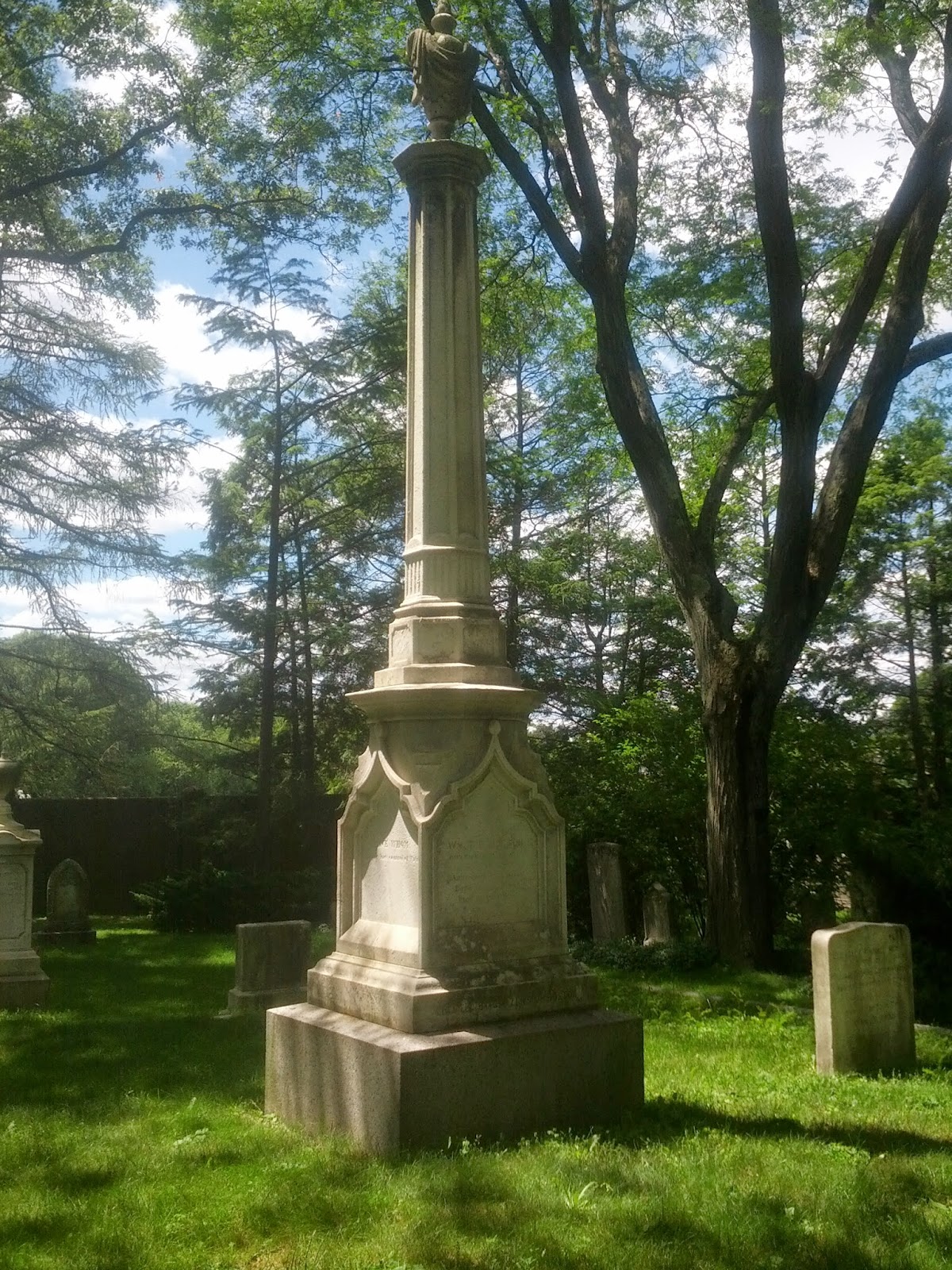
2

Lieutenant Colonel James Savage of the Second Massachusetts Infantry Regiment died October 22, 1862 as a prisoner of war from wounds received at the Battle of Cedar Mountain on August 9, 1862. This gravestone in Mount Auburn Cemetery is a cenotaph, as his body lies in Virginia. A carte de visite photograph of Lieutenant Colonel Savage can be viewed on the Massachusetts Historical Society website.

3

Edward Everett (1794 - 1865) was a U.S. Representative and Senator from Massachusetts and also served as Governor of Massachusetts from 1836 to 1840. He was recognized for his elocution skills, most notably for his long speech at the dedication of the Soldiers’ Cemetery at Gettysburg on November 21, 1863. Everett’s two-hour speech preceded the two-minute speech of President Abraham Lincoln. Lincoln’s 272-word speech, the Gettysburg Address, eclipsed Everett’s presentation and has since been recognized as a masterpiece of our historical landscape, . After President Lincoln’s concise and eloquent delivery at Gettysburg Everett remarked to Lincoln, "I should be glad if I could flatter myself that I came as near to the central idea of the occasion, in two hours, as you did in two minutes."

4

Thomas Edward Chickering (1824 – 1871) was the son of Jonas Chickering, founder of Chickering and Sons, one of the earliest piano manufacturers in the United States. During the Civil War Thomas was promoted to Colonel of 41st Massachusetts Volunteer Infantry, which was later consolidated with three Cavalry units to become the 3rd Massachusetts Cavalry during the Siege of Port Hudson, Louisiana, in 1863. He was also appointed military governor of Opelousas, Louisiana. In 1866 he received the honorary rank of brevet brigadier general for his Civil War service. In postwar civilian life he was the senior partner of Chickering and Sons until his death in 1871 at the age of 47 years.

5

Sergeant Major Joseph Oliver Miles served in Company D of the 13th Massachusetts Infantry and died of disease on August 5, 1864.

6

George Lewis Ruffin (1834 – 1886) was an attorney and judge. He was the first African American to graduate from Harvard Law School. George served on the Boston City Council and was elected to the Massachusetts State Council. He was appointed as a judge to the Charlestown District Municipal Court, becoming the first African American judge in the United States. His wife, Josephine St. Pierre Ruffin (1842 – 1924) was a pioneer for social justice, founding the first newspaper for African American women, Women’s Era, and organizing the advocacy group, the National Federation of African-American Women, which later merged with the Colored Women’s League to become the National Association of Colored Women’s Clubs. Josephine also founded the Women’s Era Club which later became the New Era Club.

7

Charles Appleton Longfellow (1844 – 1893), son of Fireside poet Henry Wadsworth Longfellow and second wife Fanny Appleton, served as a Lieutenant in the First Massachusetts Cavalry during the Civil War. He survived the war and resumed his passion for yachting, making sea journeys to Russia, China, Japan, and Indonesia.

8

I was deeply moved by episodes in the lives of the Bowditch family observed during a recent PBS American Experience documentary entitled Death and the Civil War, and I decided to visit the Bowditch lot on Tulip Path after the walk concluded to pay my respects.

Nathaniel Bowditch (1773-1838) was a mathematician, astronomer and navigator, and the founder of modern maritime navigation. He authored a book on navigation, The New American Practical Navigator, which is widely used today and is carried on board every commissioned U.S. naval ship. 9

Nathaniel's son Henry Ingersoll Bowditch (1808-1892), was a physician and abolitionist. The recent PBS American Experience documentary, Death and the Civil War, based on Drew Gilpin Faust's book This Republic of Suffering: Death and the American Civil War, showcased Henry's devotion to his son Nathaniel, a Lieutenant in the First Massachusetts Cavalry, who was mortally wounded during a cavalry charge at Kelly's Ford on March 17, 1863. Dr. Bowditch believed that his son would not have died if an ambulance system had been available to evacuate his son from the battlefield in a timely fashion. Motivated by grief but inspired by love Dr. Bowditch became an unceasing advocate for an ambulance system that was instituted by the Union Army in the spring of 1864.

10

Nathaniel Bowditch (1839-1863), Henry's son, was a Lieutenant in the First Massachusetts Cavalry Brigade and Assistant Adjutant General to Colonel Alfred DuffiƩ. He was mortally wounded during a cavalry charge at Kelly's Ford on March 17, 1863.

11

For additional information about Civil War walks at Mount Auburn please visit http://mountauburn.org/tag/civil-war/. For other events at Mount Auburn please visit their calendar of events at http://www.mountauburn.org/category/events. For additional information about previous Civil War walks at Mount Auburn Cemetery please visit my blog posts labeled Mount Auburn Cemetery and Civil War Walking Tours.

For additional information about the excellent American Experience PBS documentary Death and the Civil War please visit http://www.pbs.org/wgbh/americanexperience/films/death/. A full transcript of the documentary is available at http://www.pbs.org/wgbh/americanexperience/features/transcript/death-transcript/.

References:
1Mount Auburn Cemetery (Cambridge, Middlesex County, Massachusetts), Charles Turner Torrey monument, Spruce Avenue, Lot 1282, photographed by Carol Swaine-Kuzel, 21 June 2014. "Charles Turner Torrey," Charles Turner Torrey - Wikipedia, the Free Encyclopedia (http://en.wikipedia.org/wiki/Charles_Turner_Torrey: 27 June 2014).
2Mount Auburn Cemetery, William T. G. Morton monument, Spruce Avenue, Lot 3940, photographed by Carol Swaine-Kuzel, 21 June 2014. "William T. G. Morton," William T. G. Morton - Wikipedia, the Free Encyclopedia (http://en.wikipedia.org/wiki/William_T._G._Morton: 27 June 2014).
3Mount Auburn Cemetery, James Savage marker, Walnut Avenue, Lot 178, photographed by Carol Swaine-Kuzel, 21 June 2014. "Massachusetts in the Civil War 1861-1862," Massachusetts Historical Society: Cedar Mountain (http://www.masshist.org/features/massachusetts-in-the-civil-war-1861-1862/cedar-mountain: 27 June 2014).
4Mount Auburn Cemetery, Edward Everett marker, Magnolia Avenue, Lot 17, photographed by Carol Swaine-Kuzel, 21 June 2014. "Edward Everett," Edward Everett - Wikipedia, the Free Encyclopedia (http://en.wikipedia.org/wiki/Edward_Everett: 27 June 2014).
5Mount Auburn Cemetery, Chickering family monument, Magnolia Avenue, Lot 2282, photographed by Carol Swaine-Kuzel, 21 June 2014. "Thomas Edward Chickering," Thomas Edward Chickering - Wikipedia, the Free Encyclopedia (http://en.wikipedia.org/wiki/Thomas_Edward_Chickering: 27 June 2014).
6Mount Auburn Cemetery, Joseph Miles marker, Chestnut Avenue, Lot 1053, photographed by Carol Swaine-Kuzel, 21 June 2014.
7Mount Auburn Cemetery, Ruffin family monument, Indian Ridge Path, Lot 4960, photographed by Carol Swaine-Kuzel, 21 June 2014. "George Lewis Ruffin," George Lewis Ruffin - Wikipedia, the Free Encyclopedia (http://en.wikipedia.org/wiki/George_Lewis_Ruffin: 27 June 2014). "Josephine St. Pierre Ruffin," Josephine St. Pierre Ruffin - Wikipedia, the Free Encyclopedia (http://en.wikipedia.org/wiki/Josephine_St._Pierre_Ruffin: 27 June 2014).
8Mount Auburn Cemetery, Charles Appleton Longfellow marker, Indian Ridge Path, Lot 580, photographed by Carol Swaine-Kuzel, 21 June 2014. "Charles Longfellow," Charles Longfellow - Longfellow House Washington's Headquarters National Historic Site (http://www.nps.gov/long/historyculture/charles-longfellow.htm: 27 June 2014).
9Mount Auburn Cemetery, Nathaniel Bowditch marker, Tulip Path, Lot 1207, photographed by Carol Swaine-Kuzel, 21 June 2014. "Nathaniel Bowditch," Nathaniel Bowditch - Wikipedia, the Free Encyclopedia (http://en.wikipedia.org/wiki/Nathaniel_Bowditch: 27 June 2014).
10Mount Auburn Cemetery, Henry Ingersoll Bowditch marker, Tulip Path, Lot 1206, photographed by Carol Swaine-Kuzel, 21 June 2014. "Transcript: Death and the Civil War," Transcript. Death and the Civil War. American Experience. WGBH|PBS. (http://www.pbs.org/wgbh/americanexperience/features/transcript/death-transcript/: 27 June 2014).
11Mount Auburn Cemetery, Nathaniel Bowditch marker, Tulip Path, Lot 1206, photographed by Carol Swaine-Kuzel, 21 June 2014.

Friday, May 16, 2014

Battle of the Wilderness Walking Tour at Mount Auburn Cemetery

On Saturday I attended a Civil War themed walking tour at Mount Auburn Cemetery in Cambridge to commemorate the sesquicentennial anniversary of the Battle of the Wilderness, a two-day conflagration which took place on May 5-6, 1864, in the woods and farmlands of Spotsylvania County, Virginia. The Battle of the Wilderness was the inaugural conflict of Union General Ulysses S. Grant's Overland Campaign, a series of brutal battles in Virginia with the objective to capture the Confederate capital at Richmond. We began our tour with an introductory presentation on the battle at Story Chapel and then began our visits to the gravesites of officers, enlisted, and civilians who took part in this fateful battle.

Lieutenant Colonel Waldo Merriam of the 16th Massachusetts Infantry Regiment fought at the Battle of the Wilderness and was subsequently killed at the Battle of Spotsylvania on May 12, 1864. He was a member of the Massachusetts First Corps of Cadets, a military organization dating from 1741 which provided officers and recruits for Massachusetts regiments.

1

Henry May Bond was an adjutant with the 20th Massachusetts Infantry Regiment. He was wounded in the jaw on May 6 at the Battle of the Wilderness and was subsequently transported in an ambulance to a hospital with other wounded officers of his regiment. On the route Henry's ambulance was intercepted by Confederate Colonel John Singleton Mosby's Raiders. Henry was tragically and fatally wounded in the encounter.

2

Famed artist Winslow Homer was an artist correspondent for Harper's Weekly magazine during the Civil War years. His sketches and drawings brought a visual representation of the war to civilians and families on the home front.

3

Henry Larcom Abbot was an army engineer and brigadier general with the Union Army. He engineered and led the siege artillery brigade at Petersburg and Richmond.

4

John Michael Tobin of the 9th Massachusetts Infantry Regiment won the Medal of Honor for his exemplary service at the Battle of Malvern Hill on July 1, 1862. Tobin took voluntary command of the 9th Massachusetts Infantry after the wounding of regimental commander Colonel Thomas Cass, rallying and reforming the regiment and twice picking up the regimental colors during a series of attacks.

5

Joseph S. Hills was a captain in the 16th Massachusetts Infantry Regiment who was killed at the Battle of the Wilderness on May 6, 1864. He fell while leading and encouraging his men forward during the fight. His gravestone memorial prominently displays a hat and sword to commemorate his Civil War service, along with inscriptions for fidelity and bravery under fire.

6

Charles Folsom served as quartermaster in the 20th Massachusetts Infantry Regiment during the Civil War and was subsequently a superintendent of Mount Auburn Cemetery.

7

Charles Devens was a brigadier general in the 15th Massachusetts Regiment Infantry. His unit was the first to occupy Richmond in 1865.

8

Zabdiel Boylston Adams was a surgeon with the 36th Massachusetts Regiment. He pioneered techniques for treatment of wounded soldiers on the battlefield. He was captured by Confederate forces at the Battle of the Wilderness and treated his own wounds by pouring pure nitric acid directly into his gangrenous leg.

9

Lieutenant Colonel Theodore Lyman was an archivist and an aide-de-camp to General George Meade, commander of the Army of the Potomac, at the Battle of the Wilderness. Lyman documented his Civil War service in a compilation of letters and diaries.

10

Henry Todd, a colorbearer for the 36th Massachusetts Infantry Regiment, was killed waving his unit's colors at the Battle of the Wilderness on May 6, 1864. His gravestone commemorates his service as colorbearer for his regiment.

11

Charles Carleton Coffin was a journalist and Civil War correspondent. He accompanied the Army of the Potomac for the entire duration of the war and was an eyewitness to major battles.

12

Mount Auburn docents Bill McEvoy and Rosemarie Smurzynski were our wonderful guides for this moving and informative tour. For additional information about Civil War walks at Mount Auburn please visit http://mountauburn.org/tag/civil-war/. For other events at Mount Auburn please visit their calendar of events at http://www.mountauburn.org/category/events. For additional information about previous Civil War walks at Mount Auburn Cemetery please visit my blog posts labeled Mount Auburn Cemetery and Civil War Walking Tours.

References:
1Mount Auburn Cemetery (Cambridge, Middlesex County, Massachusetts), Waldo Merriam marker, Fountain Avenue, Lot 2922, photographed by Carol Swaine-Kuzel, 10 May 2014.
2Mount Auburn Cemetery, Bond family marker, Indian Ridge Path, Lot 156, photographed by Carol Swaine-Kuzel, 10 May 2014.
3Mount Auburn Cemetery, Winslow Homer marker, Lily Path, Lot 563, photographed by Carol Swaine-Kuzel, 10 May 2014.
4Mount Auburn Cemetery, Henry Larcom Abbot marker, Fuchsia Path, Lot 3705, photographed by Carol Swaine-Kuzel, 10 May 2014.
5Mount Auburn Cemetery, John Michael Tobin,Chestnut Avenue, Lot 1049, photographed by Carol Swaine-Kuzel, 10 May 2014.
6Mount Auburn Cemetery, Joseph S. Hills marker, Petunia Path, Lot 1450, photographed by Carol Swaine-Kuzel, 10 May 2014.
7Mount Auburn Cemetery, Charles Folsom marker, Myrtle Path, Lot 33, photographed by Carol Swaine-Kuzel, 10 May 2014.
8Mount Auburn Cemetery, Charles Devens marker, Tulip Path, Lot 1594, photographed by Carol Swaine-Kuzel, 10 May 2014.
9"Lecture, Mitchell Adams, Dr. Zabdiel Boylston Adams: Surgeon and Soldier for the Union," Lecture, Mitchell Adams, Dr. Zabdiel Boylston Adams: Surgeon and Soldier for the Union (http://www.bostonathenaeum.org/events/1739/lecture-mitchell-adams-dr-zabdiel-boylston-adams-surgeon-and-solider-union: 16 May 2014). Mount Auburn Cemetery, Zabdiel Boylston Adams marker, Elder Path, Lot 2700, photographed by Carol Swaine-Kuzel, 10 May 2014.
10Mount Auburn Cemetery, Theodore Lyman marker, Pilgrim Path, Lot 705, photographed by Carol Swaine-Kuzel, 10 May 2014.
11Mount Auburn Cemetery, Henry Todd marker, Spruce Avenue, Lot 1762,photographed by Carol Swaine-Kuzel, 10 May 2014.
12Mount Auburn Cemetery, Charles Carleton Coffin marker, Gentian Path, Lot 5981, photographed by Carol Swaine-Kuzel, 10 May 2014.

Wednesday, September 25, 2013

Discover the Civil War at Mount Auburn Walk - September 21, 2013

On Saturday I attended a Civil War theme walk at Mount Auburn Cemetery entitled Discover the Civil War at Mount Auburn, an ongoing series of walks held at Mount Auburn every other month during the year.

The walk focused on notable figures who participated in political or civilian service on the home front and in military service in the Civil War.

Originally from Philadelphia, Pennsylvania, the Hallowell family were Quakers and ardent abolitionists who relocated to Medford, Massachusetts. Brothers Edward and Norwood Hallowell, formerly with the 20th Massachusetts Infantry Regiment, served under Colonel Robert Gould Shaw of the 54th Massachusetts Infantry Regiment and survived the conflict at Fort Warren. Edward assumed the role of Colonel of the 54th Massachusetts after Robert Gould Shaw's death. Their brother Richard was appointed by Governor John Andrew as a recruiter for the 54th Massachusetts Infantry. All three brothers survived the Civil War and are buried at Mount Auburn Cemetery on Indian Ridge Path.

1

2


3

Fireside poet Henry Wadsworth Longfellow, author of many notable poems including "Paul Revere's Ride," "Evangeline," and "The Song of Hiawatha," was a devoted supporter of abolitionism and reunification of Northern and Southern states during and after the Civil War.

4

Physician and Fireside poet Oliver Wendell Holmes Sr. was the father of Oliver Wendell Holmes Jr., who enlisted in the 20th Massachusetts Infantry Regiment during the Civil War and later became a Supreme Court Justice. Oliver Wendell Holmes Sr. published many of his literary works in the Atlantic Monthly.

5

Colonel Thomas Cass, an Irish immigrant, served as commander of the 9th Massachusetts Regiment, a regiment of Irish recruits. Colonel Cass was mortally wounded at the Battle of Malvern Hill on July 1, 1862, the final of the Seven Days Battles of the Peninsula Campaign.

6

Adjacent to the Colonel Cass memorial is the gravestone of John Micheal Tobin of the 9th Massachusetts Infantry Regiment, who won the Medal of Honor for his exemplary service at the Battle of Malvern Hill on July 1, 1862. Tobin took voluntary command of the 9th Massachusetts Infantry after Colonel Cass was wounded, rallying and reforming the regiment and twice picking up the regimental colors during a series of attacks.7

8

Nearby is the memorial to Joseph S. Hills, a Captain in the 16th Massachusetts Infantry Regiment, who was killed at the Battle of the Wilderness on May 6, 1864. His gravestone memorial prominently displays a hat and sword to commemorate his Civil War service.

9

Charles W. Folsom was quartermaster for the 20th Massachusetts Infantry Regiment during the Civil War and later became a superintendent of Mount Auburn Cemetery. He is buried in the same plot as his parents.10

11

Brothers Edward and Paul Revere served in the 20th Massachusetts Infantry Regiment and gave the full measure of their devotion to the Union with their lives. Edward was an assistant surgeon for the 20th Massachusetts Regiment and was killed at the Battle of Antietam on September 17, 1862 while tending the wounded on the battlefield.

12

Paul was Colonel of the 20th Massachusetts Regiment during the Gettysburg Campaign and was mortally wounded on the battlefield on July 2, 1863.

13

The brothers rest in the Revere family plot with their father, Joseph Warren Revere, son of the famous midnight rider Paul Revere, who spread the alarm of the impending approach of the British Regulars through Lexington on the evening of April 18, 1775.

14

Charles Sumner, one of the most prominent politicians of the Civil War era, was an unceasing advocate for the abolitionist movement. His efforts almost resulted in his death when he was caned by Preston Brooks on the floor of the U.S. Senate.

15

Edwin Booth gained fame as a Shakespearean actor and notoriety as the brother of John Wilkes Booth, the assassin of President Lincoln.

16


Henry Todd, a colorbearer for the 36th Massachusetts Infantry Regiment, was tragically killed at the Battle of the Wilderness on May 6, 1864. His gravestone commemorates his service as colorbearer for his regiment.

17


Dorothea Dix was superintendent of nurses during the Civil War and an activist for the mentally ill.

18

Charles Carleton Coffin was a journalist and Civil War correspondent. He accompanied the Army of the Potomac for the entire duration of the war and was an eyewitness to major battles.

19


Rosemarie Smurzynski, a Mount Auburn docent, was a wonderful guide for this fascinating history walk. Civil War walks are an ongoing series of events at Mount Auburn Cemetery to commemorate the sesquicentennial of the Civil War. For additional information about Civil War walks at Mount Auburn please visit http://www.mountauburn.org/2013/the-civil-war. For other events at Mount Auburn please visit their calendar of events at http://www.mountauburn.org/category/events.

For additional information about the Hallowell brothers please visit my blog post Remembering the Civil War at Mount Auburn and my Civil War blog Twentieth Massachusetts Regiment 150 Anniversary.

For additional information about Colonel Thomas Cass and Charles Sumner please visit my blog post Boston in the Civil War Walk at Mount Auburn Cemetery.

For information about monuments to Colonel Thomas Cass and Charles Sumner and to the gravestone of Paul Revere, please visit my blog post Boston in the Civil War Walk at Mount Auburn Cemetery - Continued.

For additional information about the Beacon Hill home of Edwin Booth and the Beacon Hill birthplace of Charles Sumner, please visit my Beacon Hill Civil War walk post Beacon Hill Civil War Walking Tour.

For additional information about the Revere brothers please visit my blog posts Boston in the Civil War Walk at Mount Auburn Cemetery and Remembering the Civil War at Mount Auburn and my Civil War blog Twentieth Massachusetts Regiment 150 Anniversary.

For additional information about Dorothea Dix please visit my blog post Banks Brigade Bee Walk at Mount Auburn Cemetery

References:
1Mount Auburn Cemetery (Cambridge, Middlesex County, Massachusetts), Edward N. Hallowell marker, Indian Ridge Path, Lot 4124, photographed by Carol Swaine-Kuzel, 21 September 2013.
2Mount Auburn Cemetery, Norwood P. Hallowell marker, Indian Ridge Path, Lot 4124, photographed by Carol Swaine-Kuzel, 21 September 2013.
3Mount Auburn Cemetery, Richard Hallowell marker, Indian Ridge Path, Lot 4124, photographed by Carol Swaine-Kuzel, 21 September 2013.
4Mount Auburn Cemetery, Henry Wadsworth Longfellow sarcophagus, Indian Ridge Path, Lot 580, photographed by Carol Swaine-Kuzel, 21 September 2013.
5Mount Auburn Cemetery, Oliver Wendell Holmes marker, Lime Avenue, Lot 2147, photographed by Carol Swaine-Kuzel, 21 September 2013.
6Mount Auburn Cemetery, Thomas Cass marker, Chestnut Avenue, Lot 1049, photographed by Carol Swaine-Kuzel, 21 September 2013.
7John Michael Tobin, "Military Times Hall of Valor," Valor Awards for John Michael Tobin, (http://projects.militarytimes.com/citations-medals-awards/recipient.php?recipientid=1966: 25 September 2013).
8Mount Auburn Cemetery, John Micheal Tobin marker, Chestnut Avenue, Lot 1049, photographed by Carol Swaine-Kuzel, 21 September 2013.
9Mount Auburn Cemetery, Joseph S. Hills monument, Petunia Path, Lot 1450, photographed by Carol Swaine-Kuzel, 21 September 2013.
10"Col. Charles W. Folsom,", The Cambridge Chronicle, 21 May 1904, online archives (http://cambridge.dlconsulting.com/cgi-bin/cambridge?a=d&d=Chronicle19040521-01.2.8521 : accessed 22 September 2013), citing original p. 7, col. 5.
11Mount Auburn Cemetery, Charles Folsom marker, Myrtle Path, Lot 33, photographed by Carol Swaine-Kuzel, 21 September 2013.
12Mount Auburn Cemetery, Edward H. Revere marker, Walnut Avenue, Lot 286, photographed by Carol Swaine-Kuzel, 21 September 2013.
13Mount Auburn Cemetery, Paul J. Revere marker, Walnut Avenue, Lot 286, photographed by Carol Swaine-Kuzel, 21 September 2013.
14Mount Auburn Cemetery, Joseph Warren Revere marker, Walnut Avenue, Lot 286, photographed by Carol Swaine-Kuzel, 21 September 2013.
15Mount Auburn Cemetery, Charles Sumner monument, Arethusa Path, Lot 2447, photographed by Carol Swaine-Kuzel, 21 September 2013.
16Mount Auburn Cemetery, Edwin Booth marker, Anemone Path, Lot 3281, photographed by Carol Swaine-Kuzel, 21 September 2013.
17Mount Auburn Cemetery, Henry Todd marker, Spruce Avenue, Lot 1762, photographed by Carol Swaine-Kuzel, 21 September 2013.
18Mount Auburn Cemetery, Dorothea Dix marker, Spruce Avenue, Lot 4731, photographed by Carol Swaine-Kuzel, 21 September 2013.
19Mount Auburn Cemetery, Charles Carleton Coffin marker, Gentian Path, Lot 5781, photographed by Carol Swaine-Kuzel, 21 September 2013.

Wednesday, September 4, 2013

Boston in the Civil War Walk at Mount Auburn - Continued

While in Boston on a recent weekend I visited memorials to several of the figures in my recent post, Boston in the Civil War Walk at Mount Auburn Cemetery.

Thomas Cass, Colonel of the 9th Massachusetts Volunteer Regiment, was mortally wounded at Malvern Hill on July 1, 1862. Members of his regiment erected a statue in his honor, which was unveiled on the Boylston Street perimeter of the Boston Public Garden in 1899.


Located nearby on the Boylston Street perimeter of the Boston Public Garden is a statue to abolitionist Senator Charles Sumner.


A short distance away on Tremont Street is the Granary Burying Ground, the final resting place of Revolutionary War notable and midnight rider Paul Revere.

Colonel Thomas Cass, Charles Sumner, and Paul Revere's son Joseph Warren Revere and grandsons Paul and Edward Revere, officers in the 20th Massachusetts Volunteer Regiment, are buried in Mount Auburn Cemetery.

1

For additional information about these important figures in American history please visit my blog post Boston in the Civil War Walk at Mount Auburn Cemetery.

References:
1Granary Burying Ground (Boston, Suffolk, Massachusetts), Paul Revere gravestone, Section D, Lot 23, photographed by Carol Swaine-Kuzel, 24 August 2013.